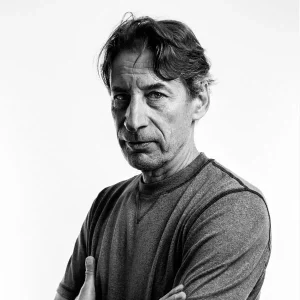
Predgovor Rudija Urana katalogu moje samostalne fotografske izložbe „Vmes“, održane u Mariboru 2026. godine. Tekst promatra odnos figure i prostora, tišinu, prazninu i fotografiju kao osobni vizualni dnevnik.
VMES
Fotografije Zorana Kolarića
Ko gledam fotografije Zorana Kolarića, imam občutek, da ga prostor zanima bolj kot človek. Čeprav vanj pogosto postavlja figuro, ta nikoli ne postane glavni protagonist. Ne pripoveduje zgodbe, ne razkriva psihologije in ne želi vzbuditi empatije. Včasih oseba celo izgine in ostane le njena senca, kot sled nečesa, kar je bilo tam, a ni več pomembno.
Figura pri Kolariću ni razlog, zaradi katerega je fotografija nastala. Je predvsem referenca, skoraj orientacijska točka, ki namiguje, kakšen prostor gledamo in kakšno funkcijo bi ta lahko imel. Toda prav v naslednjem trenutku se ta funkcija razblini. Človek prostora ne potrdi, ga ne razgradi in mu ne pripiše novega pomena. Preprosto postane del njegove mizanscene, eden od elementov konstrukcije, tišine in praznine, ki jo avtor tako natančno gradi.
Njegove figure delujejo, kot da bi želele prostor zapustiti. Ne naselijo ga in ga ne osvojijo. Za seboj ne puščajo zgodbe, temveč občutek, da prostor obstaja neodvisno od njih in da bo obstajal tudi po njihovem odhodu.
Morda zato njegove fotografije razumem kot osebni vizualni dnevnik. Ne kot dokument prostora, ampak kot zapis odnosa do sveta. Zdi se mi, da Zoran sveta ne doživlja kot njegov uporabnik ali potrošnik, temveč kot nekdo, ki hodi vzporedno z njim. Kot opazovalec, ki nikoli povsem ne vstopi v prizor, ampak ostaja na njegovi meji.
Fotografija mu omogoča, da ta občutek prevede v podobo. Vsak kader je tiha samorefleksija, zapis o lastni drugačnosti in o odmiku do sveta, ki ga obdaja. Zato njegovi prostori niso le arhitektura ali krajina.
Postanejo mentalni prostori, brezčasni in odprti, prostori, v katerih se človek ne sprašuje več, kje je, temveč ali svetu sploh še pripada.
Rudi Uran
IN BETWEEN
Photographs by Zoran Kolarić
When I look at Zoran Kolarić’s photographs, I have the feeling that he is more interested in space than in
people. Although he often places a human figure within it, that figure never becomes the true
protagonist. It tells no story, reveals no psychology and makes no attempt to evoke empathy. Sometimes
the person disappears altogether, leaving only a shadow behind a trace of someone who was there, but
whose presence is no longer essential.
In Kolarić’s photographs, the figure is not the reason the image exists. It serves primarily as a point of
reference, almost like a visual marker suggesting what kind of place we are looking at and what its
function might be. Yet in the very next moment, that function dissolves. The figure neither confirms the
purpose of the space nor seeks to dismantle it. Instead, it becomes part of the mise-en-scène, one
element within a carefully composed structure of silence, emptiness and stillness.
His figures often seem as if they are about to leave the space. They never truly inhabit it or claim it as
their own. They leave behind no narrative, only the sense that the place exists independently of them
and will continue to exist long after they have gone.Perhaps this is why I see his photographs as a personal visual diary. Not a document of places, but a
record of one’s relationship with the world. I have the impression that Zoran does not experience the
world as its user or consumer, but as someone who moves alongside it. As an observer who never fully
enters the scene, remaining instead at its threshold.
Photography allows him to translate this feeling into images. Every frame becomes a quiet act of self-
reflection a record of his own sense of otherness and of the distance he maintains from the world around
him. For this reason, his spaces are never merely architecture or landscape. They become mental spaces:
timeless, open, and suspended between presence and absence. They are places where one no longer
asks where one is, but whether one still belongs to the world at all.
Rudi Uran